

While you may not think about it, the dye used in the construction of any type of Persian, Oriental, or Turkish rug has to come from somewhere. In traditional rug weaving, they often utilized vegetable dye. While synthetic dyes are an option, there is a general bias within the rug industry toward natural dyes. So what are vegetable dyes and are they better than their artificial counterparts?
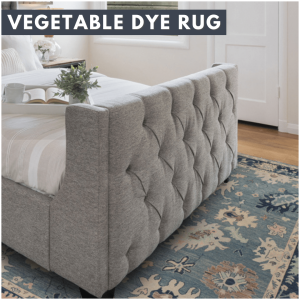
How does a weaver use vegetable dye?
Once a sheep shearer removes the wool from his or her flock, the wool is then sent to a facility to be cleaned. In this state, it has an off-white color. Some have even described it as an ivory tone.
Regardless, at this point, the weaver will mix various types of materials with water to create a dye. In the past, bugs weren’t unheard of (and if that sounds odd to you, look up how traditional Red Velvet Cake gets its color). Vegetables are what we’re talking about today, however, and plant matter such as saffron or indigo are common elements in vegetable dye.
What makes vegetable dye rugs more “desirable”?
Ever since artificial dyes were introduced, there has been a steady interest in “old world” techniques. Therefore, some equate the idea that vegetable dye rugs make a rug worth more. This, in turn, translates into a higher level of desirability for rugs using vegetable dyes, especially if the purchaser has an affinity for history.
Does this mean artificial dyes are poor quality?
Before we answer this, let’s first talk about artificial dyes. Did you know that they are not modern inventions? Of course, by modern we mean in the past few decades. In terms of the history of Persian, Oriental, and Turkish rugs then yes, artificial dyes are a relatively recent creation.
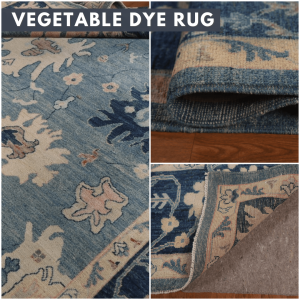
It’s believed that artificial dyes were first introduced to artisan rug weaving in the late 1800s. This was a direct result of the lack of permanence of some vegetable dye colors. With age, they would fade or rub out. This meant that the story — the weaver’s creative thought behind the rug’s design — would eventually be lost forever.
Remember, antique rugs are desirable because of their age, the story, and their handmade nature. Rug quality comes down to how the rug is made and the materials used. Quality is often a collective evaluation, and we’d be hard-pressed to say universally that all artificial dyes are poor quality. Rather, it’s the entire work that would make that kind of determination.
What are the most common vegetable dye colors?
Vegetable dye rugs produced a wide range of colors. It all depends on the type of plant being used in the dye. Some types of plants will produce striking reds and bold oranges. Other types of plants, such as the aforementioned saffron, will produce bold yellows. Using indigo is a great way to create blue. The options are relatively endless,
as (just in the color wheel) you can blend types of vegetables and other materials to produce various options.
Do you have a specific color of rug you’re looking for? Then let us know! Regardless of whether you’re looking for vegetable dye rugs or simply are looking for the right color, the team at Rug Source can help. Browse our online inventory HERE or send us a message if there’s something specific you’re looking for. We look forward to helping you!