

The world’s historic Rug Belt includes many cultures and regions. Among them is one of the world’s most populous countries: India. India is known for many things, from food to dances to entertainment and more. The country is also known for its beautiful rug exports. But what makes an Indian Rug different than other styles exactly?

Persian Influences
A quick survey of the history of Indian Rugs will quickly reveal a Persian connection. Beginning in the 16th century, the sultan Akbar brought artisans from Persia to create rugs for his palace residence. From there, Indian Rugs began to take their own shape and direction, incorporating styles and designs native to the region while maintaining the connection to their Persian roots.
As with most rug categories, production took a nosedive during the 19th century. In recent years, there’s been a renewed interest in Indian Rugs.
Oriental Classification
Oriental Rugs are a wide-ranging category spanning much of the Rug Belt. This means that Indian Rugs also fall into the broader Oriental Rug family. They contain many of the same characteristics of this grouping while retaining a unique look that’s native to India itself.
So, what makes an Indian Rug different than other styles? Let’s take a closer look at three significant characteristics.
1. A Dense Knot Count
In printing, we often hear terms like DPI or Dots Per Inch. In the rug industry, we use a different yet similar measurement: KPI, otherwise known as Knots Per Inch.
Here is one of the big things that makes an Indian Rug different than many other styles of Oriental Rugs. Depending on the weaver’s skill, the minimum knot count for an Indian Rug is 25, with the maximum being recorded as high as 194. That’s right: nearly 200 knots per inch. This means Indian Rugs are not only one of the densest KPI options on the market but also highly durable.
2. Wide Variety of Designs
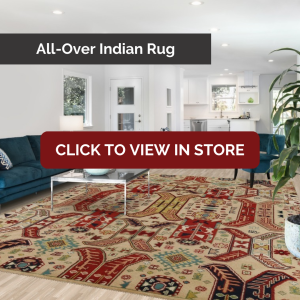
Connecting back to the Persian influence, does this mean that a rug from Iran and one from India are visually indistinguishable? Not by a long shot! In Indian Rug weaving, no two designs are alike, as you’ll find a wide range of designs, perhaps one of the largest of any rug family. From monuments to inspiration taken from cave paintings to tribal motifs and more, there is no shortage of designs with an Indian Rug.
3. High-Grade Materials
While not something that makes an Indian Rug different than other styles, it still bears repeating. Indian artisans use many of the same high-grade materials as other Oriental Rug weavers. One of the differences is that Indian Rugs use even more high-grade fabrics. The usuals — cotton, wool, and silk — are present. But so are viscose, jute, and hemp.
Browse Rug Source’s selection of Indian rugs today!
Our inventory of Indian Rugs is ever-changing, with new and exciting pieces rotating in regularly. We pride ourselves on providing the best selection of Indian Rugs. If you want to learn more about our offerings, visit our inventory here, send our team a message here, or call us today at 980-819-7373 for more information.